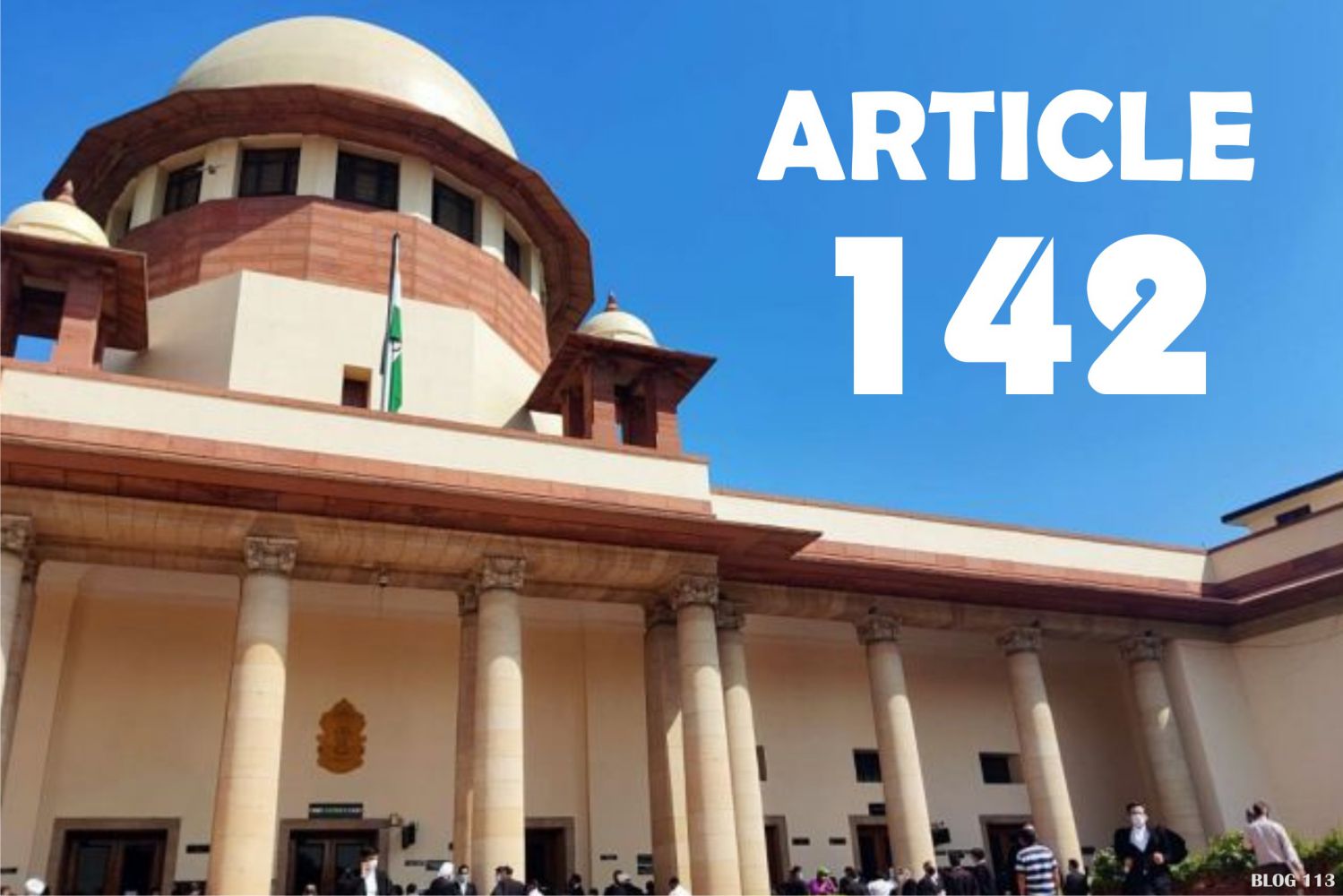
Introduction
The Constitution of India, celebrated for its comprehensive and adaptive nature, has provisions that empower various branches of government to function effectively and uphold the rule of law. One of the most significant provisions is Article 142, which grants the Supreme Court the power to pass any decree or order necessary for doing complete justice in any cause or matter pending before it. This article is not just a testament to the judiciary’s role as a guardian of justice but also highlights its ability to correct its own judgments when necessary. This blog explores the depth and breadth of Article 142, its implications, landmark cases, criticisms, and its essential role in the Indian legal system.
1. Understanding Article 142
Article 142 of the Indian Constitution states:
Complete Justice: Article 142(1) empowers the Supreme Court to pass any order necessary for doing complete justice in any case or matter pending before it. This provision is broad and inclusive, allowing the court to ensure justice is delivered even if it requires stepping beyond conventional legal boundaries.
Enforcement of Decrees and Orders: Article 142(2) enables the Supreme Court to ensure the enforcement of its decrees and orders. It allows the court to secure the attendance of any person, the discovery or production of any document, or the investigation or punishment of any contempt. This ensures the court’s mandates are implemented effectively.
2. The Power of Review
A crucial implicit power under Article 142 is the Supreme Court’s ability to review its own judgments. While Article 137 explicitly provides for the review of judgments, Article 142 strengthens this power by emphasizing the court’s role in ensuring complete justice. This power of review is essential for several reasons:
Correcting Errors: Even the highest court can make mistakes. The power to review allows the Supreme Court to rectify errors or omissions in its judgments, ensuring that justice is ultimately served.
Evolving Interpretations: Legal interpretations can change over time. The power to review enables the court to revisit its previous decisions in light of new legal principles, societal changes, or evolving jurisprudence.
Ensuring Fairness: In cases where new evidence emerges or there is a significant change in circumstances, the power to review ensures that the final outcome is just and fair.
3. Landmark Cases Leveraging Article 142
Over the years, the Supreme Court has invoked Article 142 in numerous landmark cases, demonstrating its far-reaching implications and the breadth of its application:
Vishaka vs. State of Rajasthan (1997): In the absence of specific legislation on sexual harassment at the workplace, the Supreme Court laid down comprehensive guidelines using its powers under Article 142. This case highlighted the court’s proactive role in filling legislative gaps and addressing critical social issues. The Vishaka guidelines remained the cornerstone for workplace sexual harassment policies until the enactment of the Sexual Harassment of Women at Workplace (Prevention, Prohibition and Redressal) Act in 2013.
Union Carbide Corporation vs. Union of India (1989): Following the Bhopal gas tragedy, the Supreme Court invoked Article 142 to approve a settlement between the Union of India and Union Carbide Corporation. This ensured immediate relief for the victims and demonstrated the court’s commitment to doing complete justice, even in complex and high-stakes scenarios.
Ayodhya Verdict (2019): In the landmark judgment on the Ayodhya dispute, the Supreme Court used Article 142 to allocate a different piece of land for the construction of a mosque while allowing the construction of a temple at the disputed site. This decision was aimed at ensuring peace and harmony, showcasing the court’s ability to balance justice with societal impact.
Judicial Activism vs. Judicial Overreach: The broad powers conferred by Article 142 have led to significant judicial interventions, often described as judicial activism. While this activism has been crucial in advancing social justice and human rights, it has also raised concerns about judicial overreach.
4. Judicial Activism
Judicial activism refers to the judiciary’s proactive role in protecting rights and ensuring justice, often stepping in where the legislature or executive has failed. Article 142 has been a key tool for the Supreme Court in exercising judicial activism. For instance, in cases involving environmental protection, human rights, and social justice, the court has issued comprehensive orders to address pressing issues, sometimes creating guidelines or frameworks in the absence of existing legislation.
5. Judicial Overreach
Critics argue that the broad powers under Article 142 can lead to judicial overreach, where the judiciary encroaches upon the functions of the executive and legislature. This potential overreach can disrupt the separation of powers, a fundamental principle of the Constitution. For example, the Supreme Court’s decision in the National Judicial Appointments Commission (NJAC) case was seen by some as an instance of judicial overreach, as it struck down a constitutional amendment passed by Parliament.
6. Balancing Judicial Power and Responsibility
The use of Article 142 necessitates a delicate balance. While the judiciary must ensure complete justice, it must also respect the boundaries of its constitutional role to avoid undermining the other branches of government. Several factors contribute to achieving this balance:
Self-restraint: The judiciary must exercise self-restraint and use Article 142 judiciously, ensuring that it does not overstep its boundaries or interfere unduly with the functions of the executive and legislature.
Clear Guidelines: Establishing clear guidelines for the use of Article 142 can help maintain consistency and transparency in its application. This would help in preventing arbitrary use of this power.
Judicial Accountability: Maintaining accountability through transparent judicial processes and reasoned judgments ensures that the use of Article 142 is justifiable and adheres to the principles of justice.
7. The Impact of Article 142 on the Indian Legal System
Article 142 has had a profound impact on the Indian legal system, shaping the judiciary’s approach to justice and its interaction with the other branches of government. Its implications are far-reaching:
Ensuring Justice Beyond Legal Technicalities: Article 142 empowers the Supreme Court to transcend procedural limitations and focus on the essence of justice. This ensures that justice is not thwarted by technicalities or gaps in the law.
Promoting Social Justice: The provision has been instrumental in advancing social justice, addressing issues such as gender equality, environmental protection, and human rights. It allows the court to address urgent societal concerns proactively.
Strengthening the Judiciary’s Role: Article 142 reinforces the judiciary’s role as the ultimate guardian of justice, ensuring that the court can act decisively to protect rights and uphold the rule of law.
Dynamic Interpretation of the Constitution: The use of Article 142 exemplifies the dynamic nature of the Constitution, allowing it to adapt to changing times and evolving societal needs. This dynamic interpretation ensures the Constitution remains relevant and effective.
Conclusion
Article 142 of the Indian Constitution stands as a powerful testament to the judiciary’s commitment to ensuring complete justice. Its broad and inclusive provisions empower the Supreme Court to transcend procedural limitations and address gaps in the law, ensuring that justice prevails. While its use must be balanced to avoid judicial overreach, the ability to review and rectify its own judgments underscores the court’s role as the ultimate guardian of justice.
Through its judicious application, Article 142 continues to reinforce the Supreme Court’s pivotal role in upholding the rule of law and protecting the rights of individuals. In a dynamic legal landscape, Article 142 remains a cornerstone of the Indian judiciary’s commitment to doing complete justice, ensuring that the pursuit of fairness and equity remains at the heart of the Indian legal system.